

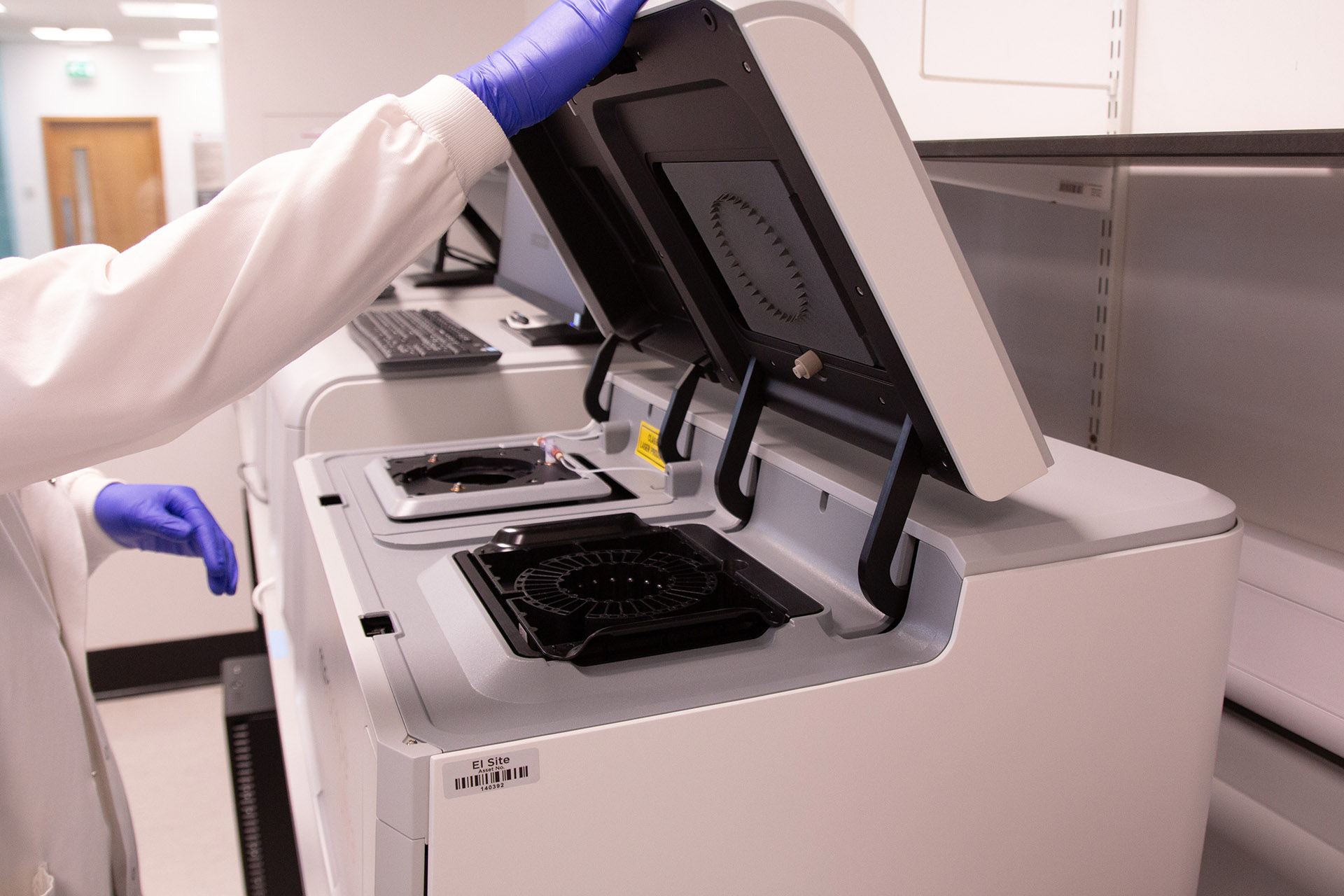
A new collaboration between the Earlham Institute and the Norfolk and Norwich University Hospital (NNUH) will drive forward patient-focused research in Norwich, using new technology that should become particularly useful in clinical research studies of cancer, neurology and rare diseases,
The collaboration will enable scientists to work with local histology (the study of microscopic anatomy of biological tissues) and spatial transcriptomics expertise, a cutting-edge technology that shows scientists where genes are active within a tissue sample, providing a detailed picture of what is happening at a cellular level. As well as helping detect medical conditions it is an important tool for research at the Earlham Institute.
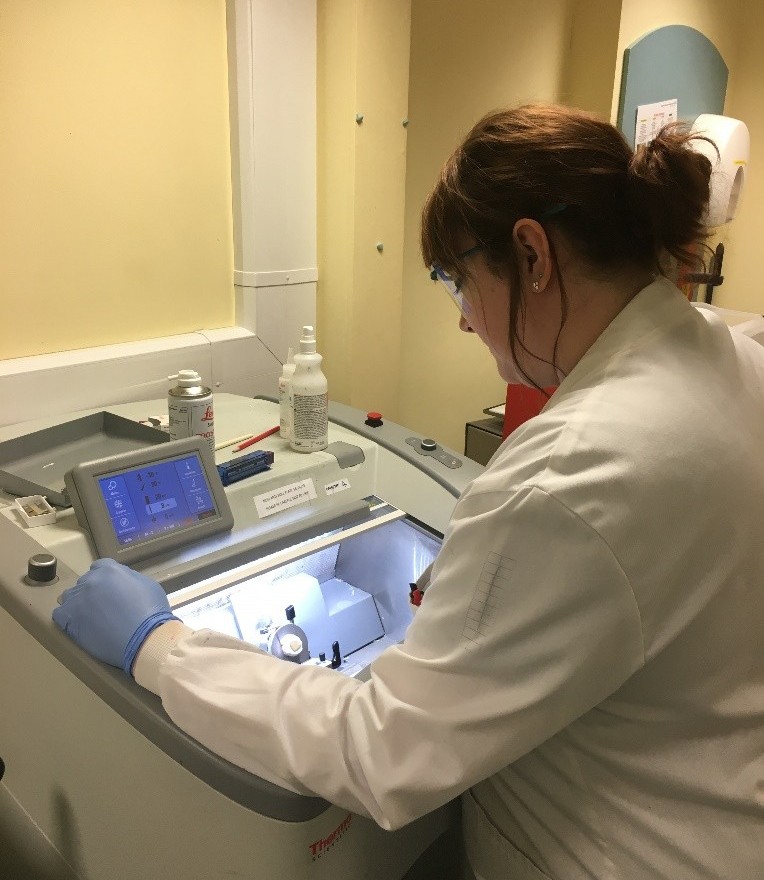
This new approach requires very thin sections of tissue to be used as samples – approximately one tenth of a human hair! To cut tissue this thin requires specialist experience and the tissue must either be frozen or preserved which enables researchers to use precious archived samples, instead of obtaining fresh tissue.
Spatial transcriptomics is transforming our understanding of cellular biology and tissue organisation. Unlike conventional approaches that dissociate tissues into individual cells, potentially losing important spatial context, spatial transcriptomics enables gene expression to be studied while preserving the tissue architecture.
This partnership builds on the sectioning expertise and methods developed at the NNUH for histopathology – diagnosing and studying diseases of tissues by examining them under a microscope – adapting and translating them for use in spatial experiments at the Earlham Institute.
Daniella Shipley, Research Assistant at the Earlham Institute said, “Tissue sectioning is a very difficult technique, but is crucially important to ensure the highest-quality data is generated for spatial transcriptomics. We work with many different tissue types and are pleased to be partnering with the outstanding histology expertise at NNUH’s Cotman Centre.”
Eleanor Gilham, Specialist Biomedical Scientist at NNUH, said, “I am delighted to be part of this exciting collaboration and being able to utilise my current skills in histology alongside the cutting-edge technology provided by the Earlham Institute, which is a valuable option for researchers.”
Rebekah Girling, Clinical Services Research Lead at NNUH said, “This is an exciting and important step for Norwich Research Park as we seek to collaborate for clinical research with our partners at the Earlham Institute and support the work of the Norfolk and Waveney region.”
This collaboration also builds on the existing relationship between the Earlham Institute and the Norwich Research Park Biorepository. The Biorepository is an invaluable resource for clinical research, storing and managing human tissue samples, provided by consenting patients, for studies into the causes and treatments of diseases.
Anyone interested in working with the spatial transcriptomics team at Earlham Institute can find out more here.

